

Will Existing Home Sales Finally Rebound in 2026? What Buyers and Sellers Should Expect
If you’re a homeowner or buyer in Warwick, East Greenwich or anywhere in Rhode Island, you’ve probably asked this question recently: Are we finally past the slowdown in home sales—and will 2026 feel any different?
National forecasts suggest a cautious answer. While economists don’t expect a dramatic rebound, many do believe the existing-home market may be stabilizing and inching toward recovery. Understanding what that means nationally—and how it translates locally—can help you make smarter real estate decisions over the next year.
Below, we break down what leading housing forecasts are signaling for U.S. existing home sales in 2026, why activity has remained historically low, and what this outlook could mean for buyers and sellers across Warwick, Cranston, East Greenwich, Coventry, North Kingstown, and greater Rhode Island.
A Quick Look Back: Why Home Sales Fell So Sharply
During the pandemic housing boom, existing-home sales surged nationwide. Ultra-low mortgage rates allowed homeowners to sell and buy again with ease, while buyers—both owner-occupants and investors—quickly absorbed available inventory.
That momentum came to an abrupt halt in 2022.
As mortgage rates rose rapidly, existing-home sales dropped to levels not seen in decades. The main culprit wasn’t demand alone—it was reduced housing turnover, often referred to as the lock-in effect.
What Is the Lock-In Effect?
Many homeowners secured mortgage rates in the 2–4% range during 2020–2021. Selling now often means:
Giving up a significantly lower monthly payment
Replacing it with a mortgage that may be several hundred dollars more per month
Or, for some households, no longer qualifying at today’s rates
As a result, fewer people are listing homes—even if they’d otherwise like to move.
National Existing-Home Sales: Where We Stand Now
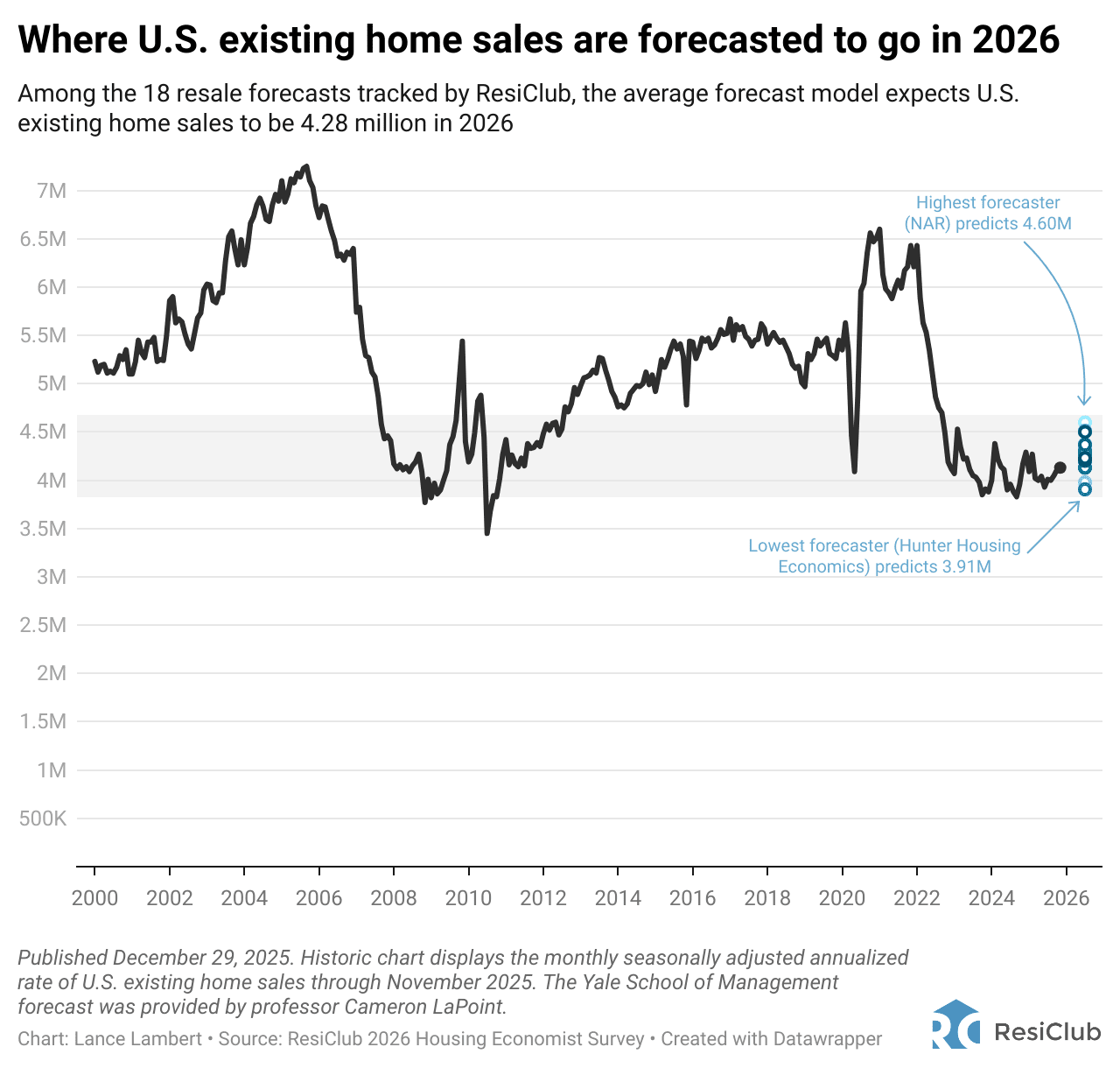
To understand where the market may be heading, it helps to look at where it’s been. Over the past several years, annualized existing-home sales have shifted dramatically:
2019–2021: Strong, above-average activity
2022–2023: A sharp correction as rates surged
2024–2025: Sales stabilized, but at historically low levels
By late 2024 and into 2025, sales volumes appeared to stop falling—but they haven’t meaningfully rebounded either.
That leads to the big question heading into 2026.
What Forecasts Are Predicting for 2026 Existing-Home Sales
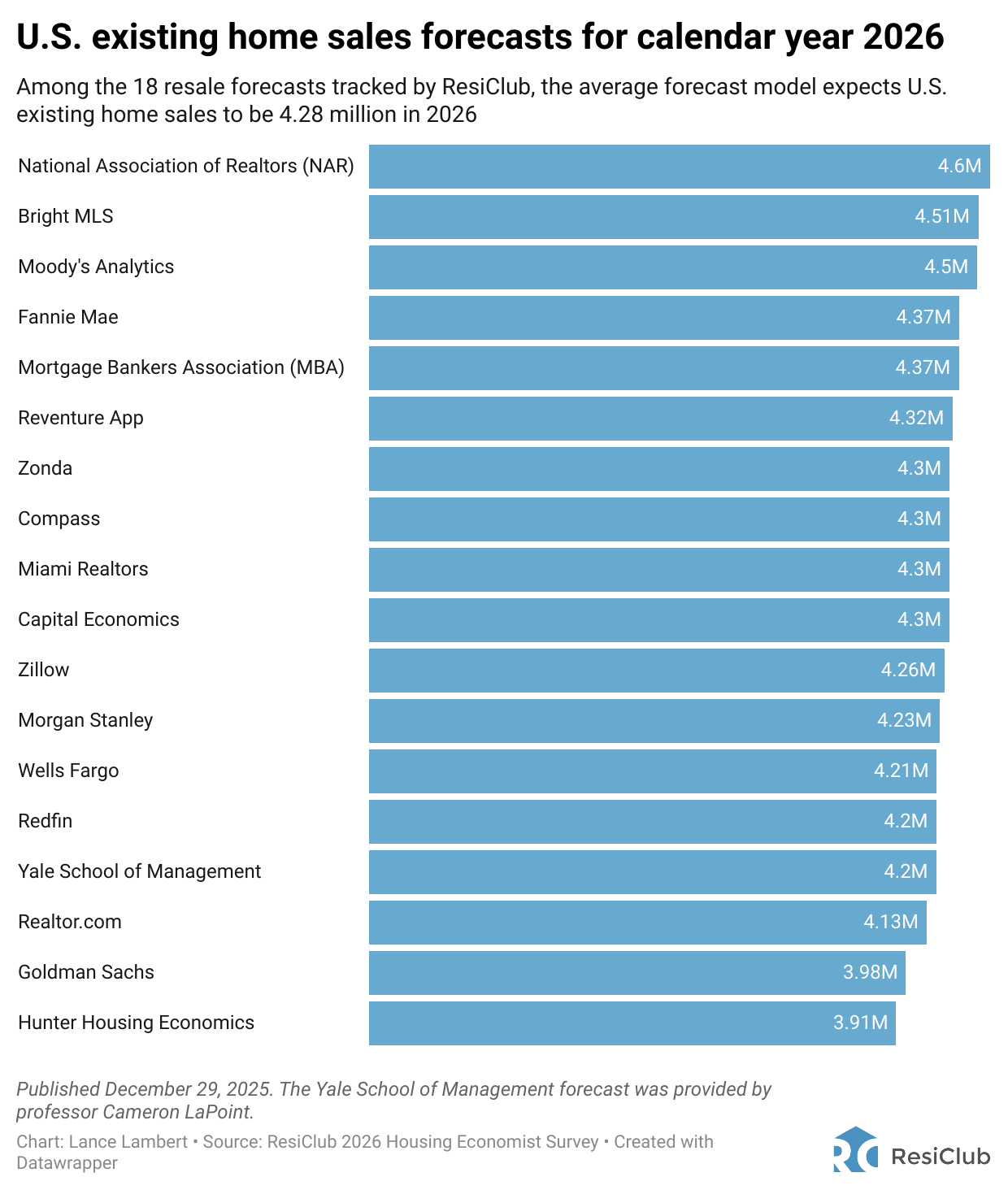
Across a wide range of economic and housing forecast models, expectations for 2026 are modestly optimistic—but restrained.
The Consensus Outlook
Average forecast for 2026 U.S. existing-home sales: ~4.3 million
That would represent a slight increase from 2025
Still well below pre-pandemic “normal” levels
In other words, many analysts believe the market may have passed its lowest point, but the recovery is expected to be slow and uneven.
Some models that extend further out anticipate a bit more momentum by 2027, with sales edging closer to the mid–4 million range nationally.
Why Forecasters See Slight Improvement in 2026
While no one is predicting a return to the frenzied market of 2020–2021, several factors could gradually support higher resale activity.
1. Life Happens—Even With Low Mortgage Rates
Over time, lifestyle changes accumulate:
Growing families
Job relocations
Downsizing or retirement
Health or caregiving needs
As incomes rise and circumstances change, more homeowners may decide that staying put no longer outweighs their low-rate mortgage.
2. Marginally Lower Mortgage Rates (Not a Collapse)
Most forecasts do not assume a dramatic drop in rates. However, many expect:
Rates in the 2026 spring market to be modestly lower than in spring 2025
Slightly improved affordability at the margins
Even small rate improvements can unlock demand for both move-up buyers and first-time purchasers.
3. Buyers Adapting to the “New Normal”
After several years of elevated rates:
Buyers have adjusted expectations
Households are recalibrating budgets
Creative solutions (rate buydowns, smaller homes, different locations) are becoming more common
This adaptation process tends to support slow, steady gains in transaction volume.
What This Means for Rhode Island Homeowners
National data sets the tone—but local markets don’t move in lockstep with national averages.
In Central Rhode Island, several dynamics continue to shape the outlook:
Inventory Remains Tight
Warwick, Cranston, East Greenwich, and surrounding towns still face:
Limited resale inventory
Few move-in-ready homes
Strong competition for well-priced listings
Even with lower national sales volume, desirable Rhode Island neighborhoods continue to attract buyers.
Prices May Stay More Stable Than Sales Volume
Low transaction volume does not automatically mean falling prices. In many Rhode Island communities:
Supply constraints remain severe
Sellers who do list often receive solid interest
Pricing corrections, where they occur, tend to be modest and localized
Sellers Have Leverage—If They Price Correctly
If you’re considering selling in 2026:
Homes that are priced accurately and presented well can still perform strongly
Overpricing, however, is less likely to be forgiven in a slower national environment
What This Means for Buyers in 2026
For buyers, the 2026 outlook offers both challenges and opportunities:
Potential Advantages
Less frantic competition than peak pandemic years
More time for due diligence
Occasional negotiating room, depending on the property
Ongoing Challenges
Limited selection in many Rhode Island towns
Higher monthly payments compared to pre-2022 norms
Need for careful financial planning
Working with a knowledgeable local agent becomes especially important in a market defined by nuance rather than headlines.
So, Is 2026 the Turning Point?
The short answer: Possibly—but don’t expect fireworks.
Most forecasts point to:
A market that has stabilized
Gradual improvement rather than a surge
Continued constraints from low inventory and homeowner lock-in
For Rhode Island buyers and sellers, success in 2026 will be less about timing the market perfectly—and more about strategy, preparation, and local expertise.
Thinking About Buying or Selling in Warwick or Central Rhode Island?
Whether you’re considering a move in 2026 or just starting to plan, having a clear, local perspective matters more than ever. National forecasts provide context—but real estate decisions are always personal and local.
If you’d like to talk through your options, market timing, or neighborhood-specific trends, Nick Slocum and The Slocum Home Team at eXp Realty are here to help. Reach out anytime for a no-pressure conversation about what makes sense for you in the year ahead.
