

Single-family home sales are down nearly 10%, but condo and multifamily sales are increasing. Here's what the latest Rhode Island real estate numbers actually tell us.
"The real estate market is frozen. Nobody's buying homes."
That's what a real estate agent told me at an industry event recently. He had a listing that wasn't selling, and he was convinced the entire housing market had come to a standstill.
But when you look at the October 2026 Rhode Island housing market data, a very different picture emerges.
Yes, single-family home sales declined nearly 10% compared with October 2025. But condominium sales increased. Multifamily sales increased. And median sale prices continued climbing in several property categories.
The Rhode Island real estate market isn't frozen. It's changing. And there's a big difference.
Higher mortgage rates, more selective buyers, and longer selling times have made this a more challenging market. But challenging doesn't mean inactive.
Let's look at the latest Rhode Island housing market statistics and what they mean if you're buying, selling, or working in real estate.
Rhode Island Housing Market Statistics: October 2026 vs. October 2025
The October numbers reveal an important trend: Rhode Island's single-family, condominium, and multifamily markets are moving in different directions.
Here's how each property category performed compared with October 2025.
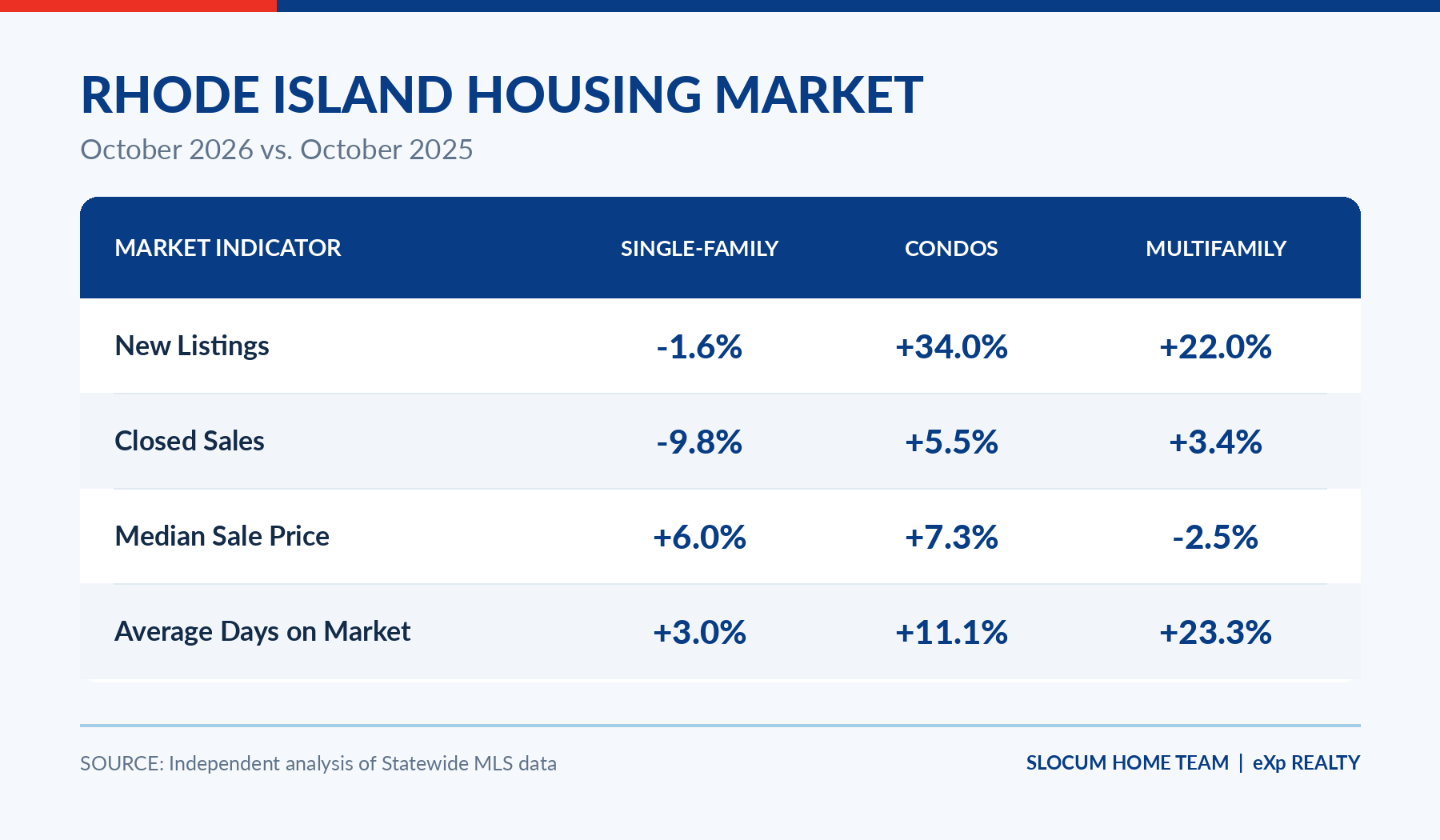
Source: Independent analysis of Statewide MLS data, October 2026 compared with October 2025. These figures are not an official statistical report published by Statewide MLS.
The takeaway is straightforward. Different segments of Rhode Island's housing market are behaving differently.
Some property types are seeing more inventory and stronger sales activity. Others are experiencing fewer transactions. And while properties are generally taking longer to sell, buyers are still purchasing homes.
That's why treating the entire Rhode Island housing market as one market can lead to the wrong conclusions.
Rhode Island Single-Family Home Market: Sales Down, Prices Up
The single-family housing market experienced a noticeable slowdown in October 2026.
New listings declined just 1.6% year over year, while homes going under contract decreased 2.6%.
Closed sales, however, fell 9.8%.
That sounds concerning at first, but there's important context behind the decline.
During September, homes going under contract were down approximately 12.5% compared with the previous year, at a time when mortgage rates were climbing. Because accepted offers typically take several weeks to reach closing, weaker contract activity in September helps explain the drop in October sales.
But here's what stands out.
Rhode Island's median single-family sale price increased approximately 6%, reaching $535,000.
Despite fewer transactions, the median price continued rising.
Meanwhile, average days on market increased just 3% compared with October 2025.
What does that tell us?
Buyer activity has slowed, but demand hasn't disappeared. Homes are still selling, and prices remain relatively strong at the statewide level.
It doesn't mean every property has increased in value by 6%. Median prices reflect the mix of homes sold, and individual property values depend on location, condition, and comparable sales.
But it does demonstrate why fewer transactions shouldn't automatically be interpreted as a housing market decline.
Rhode Island Condo Market: Listings Surge 34%
While single-family home sales declined, Rhode Island's condominium market experienced a different kind of October.
New condo listings increased 34% compared with October 2025.
At the same time, closed sales rose 5.5%, and the median condo sale price increased 7.3%.
Average days on market climbed 11.1%.
This combination is particularly interesting.
More condominium listings are entering the market, and more condos are selling. However, those properties are generally taking longer to find buyers.
For buyers, increased listing activity can create more opportunities to compare properties, evaluate pricing, and find a condo that meets their needs.
For sellers, it means there's more competition.
A condo that might have stood out when inventory was extremely limited now has to compete against a larger selection of available properties.
The Rhode Island condo market remains active, but pricing and presentation are becoming increasingly important.
Rhode Island Multifamily Market: More Inventory and Longer Selling Times
Rhode Island's multifamily housing market also experienced meaningful changes in October.
New multifamily listings increased 22% year over year, while closed sales rose 3.4%.
Unlike the single-family and condominium markets, the median multifamily sale price declined 2.5%.
And average days on market increased 23.3%.
That's the largest increase in selling time among the 3 property categories examined.
For investors and buyers considering a two-family, three-family, or other multifamily property in Rhode Island, these changes may create opportunities.
With more properties coming to market and longer selling times, some sellers may be more open to negotiating.
However, multifamily properties require an additional layer of financial analysis.
Buyers need to consider potential rental income, operating expenses, property condition, financing costs, and the property's ability to generate a reasonable return.
A reduced asking price doesn't necessarily mean a property is a good investment.
For multifamily sellers, the numbers reinforce the importance of understanding current investor expectations rather than relying on what similar properties sold for during a more competitive market.
Is Rhode Island Becoming a Buyer's Market?
One of the most common questions we're hearing is whether Rhode Island's housing market is finally shifting in favor of buyers.
The answer depends on the property.
An increase in listings or longer selling times can give buyers more negotiating opportunities. But that doesn't mean every seller is desperate or every home is overpriced.
Consider two different situations.
A home that's been sitting on the market for several weeks, with an asking price higher than comparable sales, may offer room to negotiate.
Meanwhile, a well-maintained property in a desirable Warwick, Cranston, or East Greenwich neighborhood could still attract multiple offers if it's priced competitively.
The difference comes down to the individual property and its competition.
That's why buyers should focus less on whether the overall market is favorable and more on whether a specific home represents good value.
Buyers Have More Opportunities to Protect Themselves
One of the more meaningful changes in today's market is the potential for buyers to retain important contract protections.
During the height of the competitive housing market, some buyers waived home inspections or other contingencies to make their offers more attractive.
While competitive situations still exist, buyers may now have more opportunities to include protections such as:
Home inspection contingencies.
Mortgage financing contingencies.
Requests for repairs or seller credits.
Negotiated closing dates and other contract terms.
These protections can make a significant difference when purchasing a home.
The opportunity for Rhode Island homebuyers isn't simply paying less. It's making a better-informed purchase with terms that support their long-term financial interests.
Selling a Home in Rhode Island? You Need to Be a Diamond or a Deal
If you're thinking about selling your home in Rhode Island, October's market data should reinforce one important point.
The market is still moving, but your strategy matters more than ever.
As buyers become more selective and seasonal activity slows toward the end of the year, properties need to stand out for the right reasons.
There's a phrase we use in real estate:
You need to be a diamond or a deal.
What Makes a Home a Diamond?
A diamond is a property that offers buyers a compelling combination of condition, presentation, and price.
It's well-maintained, professionally photographed, marketed effectively, and priced appropriately for current market conditions.
Buyers can recognize the value because the property compares favorably with competing listings.
What Makes a Home a Deal?
A deal is a property priced attractively enough that buyers recognize an opportunity, even if the home needs work or doesn't have every feature they're looking for.
It might need cosmetic updates, repairs, or renovations. But the asking price reflects those realities.
If your property is neither a diamond nor a deal, you may have a harder time attracting serious buyers.
Why Pricing Based on Yesterday's Market Can Hurt Your Sale
One of the biggest mistakes sellers make is assuming that what a neighbor sold for six months ago determines what their own home should sell for today.
That previous sale is useful information, but it's only part of the picture.
You also need to consider:
What comparable homes have sold for recently.
What competing properties are currently listed for.
How long similar homes are taking to sell.
Your property's condition, features, and location.
How buyers are responding to current asking prices.
A strong listing strategy combines accurate pricing, professional presentation, targeted marketing, and consistent follow-up.
The homes that succeed in a more selective market are often the ones that give buyers a clear reason to act.
What Rhode Island Real Estate Agents Can Learn From This Market
The changing market isn't just affecting buyers and sellers. It's also challenging real estate professionals to adjust how they work.
Remember the agent who said the market was frozen because his listing wasn't selling?
His frustration was understandable.
But one unsuccessful listing doesn't tell the entire story of the housing market.
October's numbers show that transactions are still happening throughout Rhode Island.
The more important questions are whether a property is priced correctly, marketed effectively, presented well, and reaching the right buyers.
The same principle applies to an agent's overall business.
When competition increases and transactions require more time and effort, the fundamentals become even more important.
That means more prospecting, more meaningful conversations, more consistent follow-up, and a stronger understanding of local market conditions.
The days when simply putting a sign in the yard could generate a line of buyers are largely behind us.
Agents need to bring measurable value to the transaction.
That includes interpreting market data, advising clients on realistic pricing, communicating clearly, and helping buyers and sellers make informed decisions.
The market isn't eliminating opportunities. It's raising the standard for the work required to find them.
Will Rhode Island Home Prices Drop in 2027?
With single-family sales slowing and inventory expanding in other property categories, it's natural to wonder where Rhode Island home prices are headed next.
October's numbers don't provide a definitive answer.
They do, however, highlight several trends worth watching.
Single-family median sale prices remain higher than they were a year ago, despite fewer closed transactions.
Condominium listings have increased considerably, but both sales activity and median prices have also risen.
Meanwhile, multifamily properties have experienced a modest decline in median sale price and a more significant increase in days on market.
These differences matter.
They suggest that future price trends may vary considerably by property type, location, and price range.
Mortgage rates, affordability, available inventory, and buyer demand will continue influencing the market.
Rather than trying to predict a statewide price crash or another surge in values, buyers and sellers should focus on the conditions affecting their particular situation.
A single-family home in Warwick doesn't necessarily respond to market changes the same way a condo in Providence or a multifamily investment property in Pawtucket does.
That's why local market knowledge is so valuable.
The Bottom Line: Rhode Island's Real Estate Market Isn't Frozen
October 2026 tells a story of a housing market in transition.
Single-family home sales declined, but median prices continued rising.
Condominium listings and sales increased.
Multifamily transactions also increased, although median prices declined and properties took longer to sell.
These aren't the characteristics of a market where nothing is happening.
They're the characteristics of a market where buyers, sellers, and real estate professionals need to adapt.
For sellers, that means pricing and presenting your property to compete in today's market.
For buyers, it means evaluating each property individually and understanding when you have room to negotiate.
For real estate agents, it means delivering stronger expertise, more consistent effort, and better service.
The Rhode Island housing market isn't frozen. It's demanding a better strategy.
And for those willing to understand the numbers and adjust accordingly, opportunities are still out there.
Buying or Selling a Home in Rhode Island? Let's Talk.
At Slocum Home Team | eXp Realty, we've been helping Rhode Islanders navigate changing real estate markets since 1949.
Whether you're considering buying a home, selling a property, or simply trying to understand what the latest housing market trends mean for your home's value, our team can help you evaluate your options.
We believe the best real estate decisions start with accurate information, local expertise, and a strategy built around your goals.
Start the conversation with Slocum Home Team to discuss what today's Rhode Island real estate market means for you.
Data source and methodology: All October 2026 statistics referenced in this article are based on independent research and analysis of data obtained from Statewide MLS, comparing October 2026 with October 2025. These figures are not official statistical reports published by Statewide MLS. Results may vary based on search criteria, methodology, and reporting dates. Statewide median sale prices do not necessarily reflect changes in individual property values.
