

Will mortgage rates finally drop in 2027? Major housing economists have different predictions, but their forecasts share one important message for anyone thinking about buying a home.
This Thanksgiving, there's a good chance someone at your dinner table will have a confident prediction about where mortgage rates are headed next year.
Maybe it's your uncle. Maybe it's a coworker. Maybe it's that one person who always seems certain about the housing market.
But what are the economists who actually study these trends predicting?
Over the past several weeks, some of the biggest names in housing economics have released their mortgage rate forecasts for 2027.
And while their predictions differ, they point toward a similar conclusion:
Mortgage rates could improve in 2027, but a return to the 3% and 4% rates we saw during the pandemic isn't part of the current outlook.
For Rhode Island homebuyers and sellers, that raises an important question.
Is it worth waiting for mortgage rates to fall, or should you be making decisions based on the market we have today?
Let's look at the numbers and what they mean for your next move.
Will Mortgage Rates Go Down in 2027? Here's What the Experts Predict
Predicting mortgage rates is difficult, even for economists who study housing and financial markets professionally.
Mortgage rates are influenced by inflation, Treasury yields, Federal Reserve policy, economic growth, and investor expectations.
That means forecasts can change quickly when economic conditions shift.
Still, looking at several major forecasts together gives us a useful picture of where the housing market may be headed.
2027 Mortgage Rate Forecast Comparison
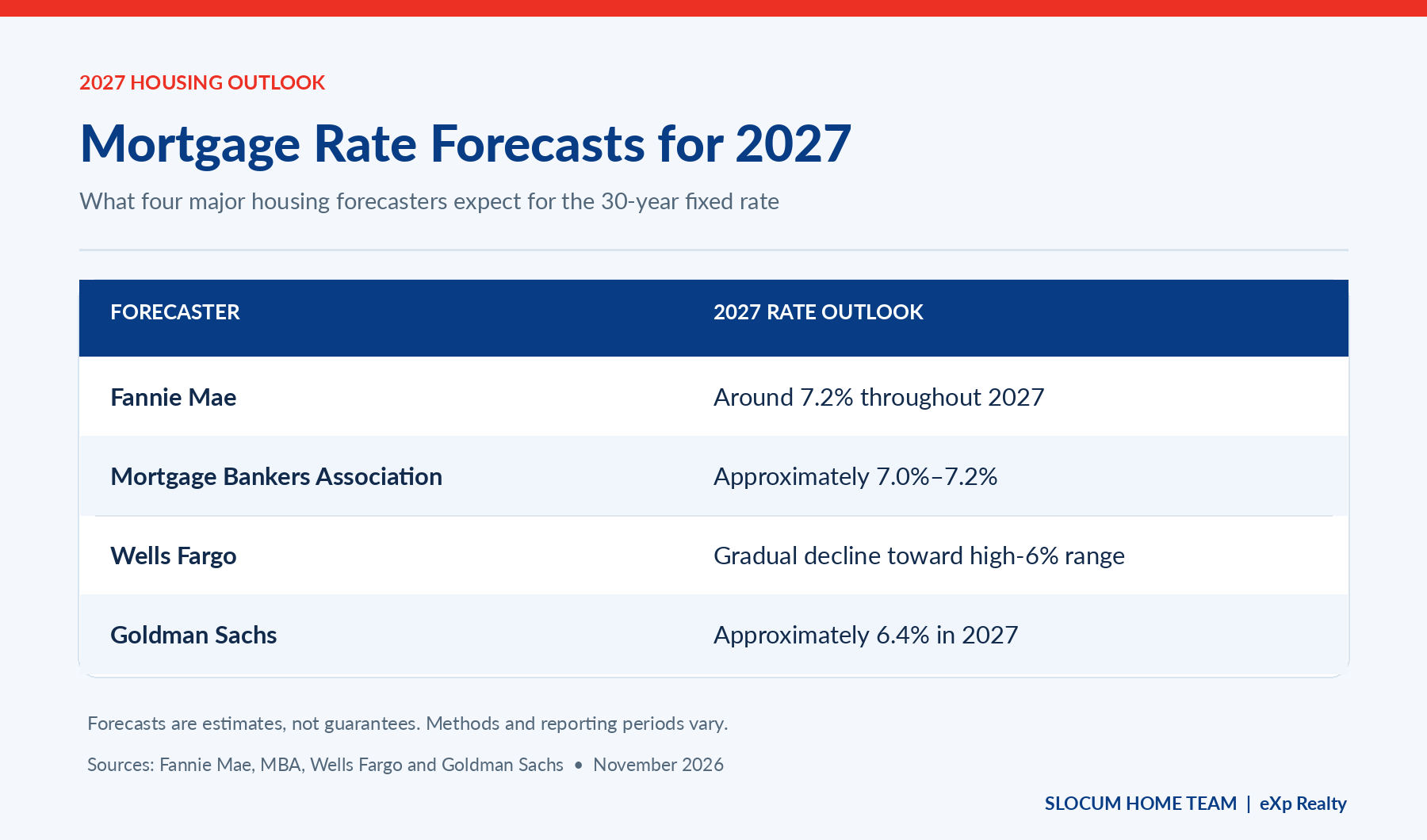
Here are some of the latest predictions for the average 30-year fixed mortgage rate.
Let's break these predictions down.
Fannie Mae: Rates remain around 7.2%.
Fannie Mae's November 2026 housing forecast projects the average 30-year fixed mortgage rate at 7.2% throughout 2027 and 2028.
In other words, Fannie Mae doesn't anticipate meaningful relief for borrowers over the next year.
Mortgage Bankers Association: Rates decline slowly.
The Mortgage Bankers Association expects mortgage rates to remain near or above 7% throughout 2027.
Its outlook suggests that any improvement in borrowing costs could happen gradually rather than through a sudden drop.
Wells Fargo: Some relief could arrive.
Wells Fargo's November projections are somewhat more optimistic, with average mortgage rates moving from approximately 7.05% in the first quarter of 2027 toward the high-6% range later in the year.
That's an improvement, but it would still leave borrowing costs substantially higher than the rates many homeowners currently have.
Goldman Sachs: Rates could reach approximately 6.4%.
Goldman Sachs offers one of the more optimistic outlooks among these major forecasts.
Its research team expects mortgage rates to decline to approximately 6.4% in 2027.
But there's an important catch.
Even with rates falling to that level, Goldman Sachs expects housing affordability to remain historically strained.
What Does the National Association of Realtors Say?
National Association of Realtors Chief Economist Lawrence Yun has also discussed how lower mortgage rates could improve homebuying activity.
He's identified rates moving closer to 6% as a potential catalyst for stronger demand.
However, NAR has postponed its formal 2027 housing outlook until December 16, 2026.
That distinction matters. A rate level that could help the market recover isn't necessarily a prediction that rates will reach it.
What Do the 2027 Mortgage Rate Forecasts Have in Common?
When you compare the available forecasts, one thing stands out.
None of these major published projections expects 30-year mortgage rates to return to 3% or 4% in 2027.
Fannie Mae expects rates to remain above 7%.
The Mortgage Bankers Association sees a slow decline, with rates still near 7%.
Wells Fargo expects some improvement.
And Goldman Sachs, one of the more optimistic forecasters, projects approximately 6.4%.
These forecasts aren't guarantees. Rates could end up higher or lower than economists currently expect.
But if you're waiting to buy a home in Rhode Island until mortgage rates return to pandemic-era levels, you may be waiting for something that isn't currently expected to happen.
That doesn't mean you need to rush into purchasing a home.
It means your financial plan should account for the possibility that borrowing costs remain elevated for an extended period.
Why Aren't More Homeowners Selling? The Mortgage Rate Lock-In Effect
Mortgage rates aren't just affecting buyers.
They're also influencing how many homes are available for sale.
And that relationship is one of the biggest reasons the housing market has been so difficult to navigate.
It's called the mortgage rate lock-in effect.
According to Goldman Sachs Research, more than 95% of American mortgage borrowers have interest rates below current market rates.
Even more significant, approximately 65% have rates at least 2 percentage points lower than today's market rates.
Think about what that means.
Imagine you purchased or refinanced your Rhode Island home several years ago and locked in a 3% mortgage rate.
Now imagine selling that property and buying another home with a mortgage rate above 7%.
Even if your new home costs roughly the same amount, your monthly mortgage payment could increase substantially.
For many homeowners, that's enough of a reason to stay where they are.
They may want a larger home, a smaller home, or a different location. But giving up their existing mortgage rate makes moving financially difficult.
So they stay put.
And when homeowners aren't listing their properties, fewer homes become available for buyers.
How the Mortgage Lock-In Effect Impacts Rhode Island Home Prices
Rhode Island has experienced limited housing inventory for years, particularly in desirable communities throughout Kent County and the surrounding areas.
When fewer homeowners choose to sell, that can restrict the available supply.
And limited supply can help support home prices, even when higher mortgage rates reduce buyer demand.
This creates an unusual situation.
The same elevated mortgage rates making homes harder to afford can also discourage existing homeowners from selling.
That doesn't guarantee prices will continue rising.
Home prices can still decline if demand weakens enough, inventory increases, or local economic conditions change.
But the mortgage lock-in effect helps explain why high borrowing costs haven't automatically produced a major nationwide housing price decline.
Goldman Sachs, for example, forecasts just 0.8% national home price growth from December 2026 to December 2027.
That's very modest appreciation, not a forecast of another rapid price surge.
And Rhode Island's housing market may behave differently from the national average.
Should You Buy a Home in Rhode Island Now or Wait Until 2027?
This is the question that matters most for prospective homebuyers.
If mortgage rates might decline next year, wouldn't waiting make sense?
Sometimes, yes.
But the decision is more complicated than simply comparing today's rate with a forecast for next year.
There are 3 important factors to consider.
1. Your Monthly Payment Matters More Than Predicting Rates
The most important number when buying a home isn't the interest rate by itself.
It's whether the total monthly payment comfortably fits your budget.
That includes:
Mortgage principal and interest.
Property taxes.
Homeowners insurance.
Mortgage insurance, if applicable.
Condo association fees, if applicable.
An allowance for maintenance and repairs.
A home can be a good purchase at a higher mortgage rate if the price and total payment make sense for your financial situation.
Conversely, even a lower mortgage rate doesn't make a home affordable if the purchase price stretches your budget too far.
Instead of trying to predict the perfect time to buy, focus on whether the numbers work for your life today.
2. Today's Market May Offer More Room to Negotiate
One potential advantage of buying while mortgage rates remain elevated is that competition can be less intense.
When affordability challenges cause some buyers to step back, prepared buyers may find opportunities that weren't available during the highly competitive market of recent years.
Depending on the property, you may be able to negotiate:
A lower purchase price.
Seller contributions toward closing costs.
Credits for repairs.
Temporary or permanent mortgage rate buydowns.
More favorable inspection and financing contingencies.
Not every Rhode Island property offers these opportunities.
A well-priced home in Warwick, Cranston, East Greenwich, or North Kingstown can still attract significant interest.
But properties that have been on the market longer, or those priced above comparable sales, may offer greater negotiating flexibility.
3. You May Be Able to Refinance Later
If mortgage rates decline after you purchase a home, refinancing may provide an opportunity to reduce your monthly payment.
However, refinancing isn't guaranteed.
You'll generally need to qualify for a new loan, have sufficient equity, and consider closing costs. Your financial circumstances and the property's value may also affect your options.
That's why buying a home based entirely on the assumption that you'll refinance next year can be risky.
A better approach is to make sure the payment works at today's rate.
Then, if rates decline and refinancing makes financial sense, you can evaluate that opportunity.
How Much Could a Lower Mortgage Rate Actually Save You?
Let's look at a simple example.
Suppose you're purchasing a $450,000 home with a 20% down payment, leaving a $360,000 mortgage.
Here's how your monthly principal and interest payment would change at different 30-year fixed mortgage rates.
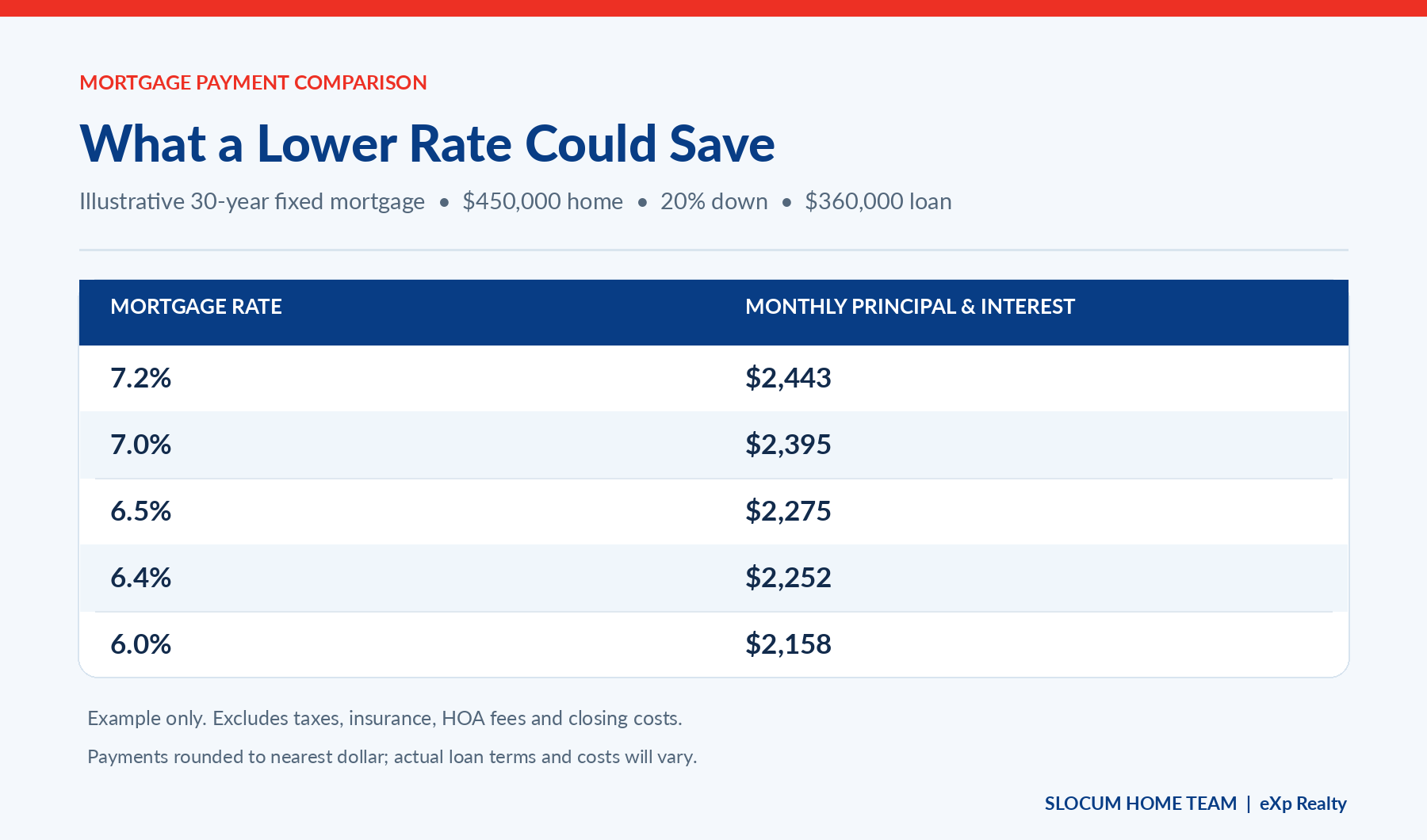
Moving from 7.2% to 6.4% would reduce the monthly principal and interest payment by approximately $191.
That's meaningful savings.
But whether waiting produces a better overall financial outcome depends on what happens to home prices, your available inventory, your down payment, and the terms you're able to negotiate.
A lower rate could improve affordability. A higher purchase price could offset some or all of that benefit.
The important thing is to evaluate both sides of the equation.
Will Rhode Island Home Prices Drop in 2027?
Mortgage rates are only one part of the housing affordability equation.
Home prices matter just as much.
Some buyers are waiting for mortgage rates to decline. Others are waiting for prices to fall significantly.
But the national outlook suggests the housing market may continue adjusting gradually rather than experiencing a dramatic reset.
Goldman Sachs expects national home prices to increase approximately 0.8% during 2027.
Fannie Mae's November forecast projects approximately 0.6% home price growth from the fourth quarter of 2026 to the fourth quarter of 2027.
Both forecasts suggest relatively flat national home prices rather than significant appreciation or a major crash.
That doesn't mean individual markets or properties can't experience declines.
Rhode Island home prices will continue to depend on local inventory, employment conditions, buyer demand, and affordability.
Conditions in Warwick may differ from those in Providence, Coventry, Cranston, or East Greenwich.
And single-family homes, condominiums, and multifamily properties can respond differently to changing market conditions.
The important takeaway is that waiting for both dramatically lower mortgage rates and dramatically lower home prices isn't a strategy supported by these current forecasts.
It remains a possibility, but not something buyers should count on.
What Should Rhode Island Home Sellers Expect in 2027?
Higher mortgage rates also create challenges for homeowners considering selling.
Buyers are more conscious of their monthly payments, which can influence what they're willing and able to offer.
That makes accurate pricing especially important.
If you're planning to sell a home in Rhode Island, your strategy should account for current buyer expectations, competing listings, and recent comparable sales.
Overpricing can cause a property to sit on the market longer, potentially leading to price reductions.
But homes that are priced appropriately, presented professionally, and marketed effectively can still attract serious buyers.
If you're selling and buying another home, you also need to evaluate the cost of your next mortgage.
For homeowners with historically low interest rates, selling may mean taking on a larger monthly payment.
However, that doesn't automatically mean staying put is the right decision.
Changes in family size, career, location, maintenance needs, and lifestyle can all make moving worthwhile.
The goal is to understand the financial trade-offs before making a decision.
The Bottom Line: Don't Build Your Homebuying Plan Around a Mortgage Rate Prediction
The leading mortgage rate forecasts for 2027 disagree on exactly how far rates might fall.
Some expect very little movement.
Others see gradual improvement.
But none of the major projections reviewed here anticipates a return to the unusually low mortgage rates of 2020 and 2021.
For Rhode Island homebuyers, that means waiting for rates to fall isn't necessarily the safest financial strategy.
For sellers, it means understanding how borrowing costs affect buyer demand and pricing expectations.
And for anyone considering a move, it means focusing on what you can actually control.
You can't control mortgage rates.
You can't control what economists predict.
And you can't control where home prices go next year.
But you can control your budget, your preparation, the properties you consider, and the strategy you use to negotiate.
The best time to buy or sell isn't determined by a forecast alone. It's determined by your finances, your goals, and the opportunities available to you.
Thinking About Buying or Selling a Home in Rhode Island?
At Slocum Home Team | eXp Realty, we've been helping Rhode Islanders make informed real estate decisions since 1949.
We know that buying or selling a home involves more than following mortgage rates or national housing headlines.
It means understanding the numbers behind your particular situation.
Whether you're considering purchasing your first home, moving into something larger, downsizing, or selling a property, our team can help you evaluate current market conditions and develop a strategy.
We'll help you understand what homes are selling for, where negotiating opportunities may exist, and how different financing scenarios could affect your next move.
Start the conversation with Slocum Home Team and let's look at the numbers together.
No pressure. No predictions disguised as promises. Just practical guidance built around your goals.
Market data and forecast disclaimer: Mortgage rate predictions are estimates, not guarantees, and are subject to change. Forecasts referenced in this article were available as of November 25, 2026. Mortgage payment examples are illustrative and do not represent actual loan offers. Consult a qualified mortgage lender for personalized financing information.
